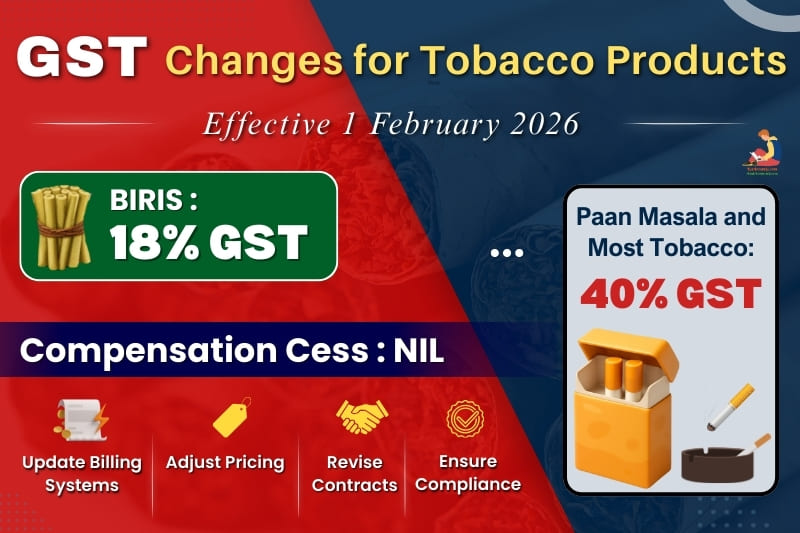
Recent GST Change for Tobacco Products (Effective 1 February 2026): An In-Depth Analysis
From 1 February 2026, the indirect tax design for tobacco and “sin goods” in India has been restructured inside GST—not just by changing rates, but also by reshaping how the tax is split across GST vs. cess. Two key moves stand out:
New GST rate structure for tobacco / pan masala items (within GST)
Compensation Cess on these products is notified as “Nil” (within GST)
This is a big compliance change for manufacturers, traders, wholesalers, retailers, and anyone doing invoicing/accounting for tobacco SKUs.
1) What exactly changed in GST from 1 Feb 2026?
A) “Biris” moved to 18% GST
A new entry inserts Biris under Schedule II – 9% CGST (i.e., 18% GST total with SGST).
HSN covered (as per the notification):
2403 19 21, 2403 19 29 – Biris
Meaning: If you deal in biris, you must update the GST rate in billing/software/master data to 18% from 1 Feb 2026.
B) Pan masala + most tobacco items moved to 40% GST
The same notification inserts multiple tobacco/pan masala items under Schedule III – 20% CGST (i.e., 40% GST total with SGST).
HSN covered (as per the notification):
2106 90 20 – Pan masala
2401 – Unmanufactured tobacco; tobacco refuse (other than tobacco leaves)
2402 – Cigars/cheroots/cigarillos/cigarettes
2403 (other than biris) – Other manufactured tobacco & substitutes; reconstituted tobacco; extracts/essences
2404 11 00 & 2404 19 00 – Inhalation products containing tobacco/nicotine substitutes (non-combustion)
So for most tobacco categories (other than biris), your GST rate becomes 40% from 1 Feb 2026.
C) A previous schedule is omitted
The notification also omits Schedule VII – 14% in the earlier framework. Practically, this signals a consolidation/cleanup of the special rate structure for these goods.
2) Compensation Cess inside GST is now “Nil” from 1 Feb 2026
A separate Compensation Cess notification substitutes the cess rate as “Nil” against multiple entries in the Compensation Cess schedule, effective 1 February 2026.
What this means in practice:
Your GST invoice/return workflow will no longer include Compensation Cess lines for the covered tobacco/pan masala items (from 1 Feb 2026), because the cess rate is notified as Nil.
However, “overall tax burden” may still remain high because the government is simultaneously using other levies (outside GST) such as excise structures (covered widely in public reporting).
3) Why did this happen? (Policy logic)
The 56th GST Council press release (Sept 3, 2025) clearly signaled that “sin goods” like pan masala, gutkha, cigarettes, unmanufactured tobacco, chewing tobacco, etc. would continue at existing GST/cess rates until compensation-cess liabilities were discharged, and also noted a shift to RSP-based levy (instead of transaction value) for these categories. Goods and Services Tax Council
In other words, this 1 Feb 2026 change is best seen as:
implementing the “transition” the Council had indicated, and
restructuring collections by moving away from Compensation Cess (now Nil) and resetting GST rate schedules for these goods.
4) Business impact: who feels it and where?
A) Manufacturers (cigarettes, chewing tobacco, pan masala)
Highest compliance impact due to:
rate change to 40% GST for most categories (except biris at 18%)
need to reconcile pricing, dealer margins, MRPs, schemes, credit notes
ERP/GST classification updates (HSN + rate mapping)
B) Wholesalers / distributors
Reprice stock movements and credit limits
Update POS billing and e-waybill integrations
Watch time of supply around 31 Jan/1 Feb cutover
C) Retailers
Billing/point-of-sale update is critical (wrong tax = wrong invoice = mismatch in customer/stock ledgers)
For B2B retailers: wrong rate can trigger ITC disputes for buyers
5) The cutover problem: supplies around 1 Feb 2026
This is where most practical errors happen.
Common risk cases
Invoice issued in Jan but goods delivered in Feb
Goods dispatched in Jan, invoice in Feb
Returns/credit notes in Feb for Jan sales
MRP printed and trade margin agreements signed before the change
Practical control: create a “rate-change SOP” for 31 Jan night:
freeze old rate billing after business hours
run a pending delivery report
ensure invoice date aligns with actual supply rules you follow internally
document basis for rate applied (audit trail)
6) What you should update immediately (checklist)
Master data & billing
Update SKU-wise HSN classification to match the notified groups (2401/2402/2403/2404, 2106 90 20, biris codes)
Update tax rate mapping:
Biris → 18%
Pan masala + most tobacco → 40%
Remove/disable Compensation Cess calculation where cess rate is now Nil
Contracts & pricing
Update distributor agreements for “tax change” clauses
Refresh rate cards, schemes, and credit note policies
GST return hygiene
Watch for:
outward tax liability differences in GSTR-1
customer mismatches (B2B buyers reconciling ITC)
old HSN-rate combinations still appearing after 1 Feb
7) Simple illustration (invoice-level)
Assume a taxable value of ₹1,00,000:
If product falls under 40% GST group (most tobacco/pan masala)
GST @ 40% = ₹40,000
Total invoice (GST only) = ₹1,40,000 (excluding any other non-GST levies)
If product is Biris (18%)
GST @ 18% = ₹18,000
Total invoice (GST only) = ₹1,18,000
(Your real consumer price may still change based on non-GST levies and pricing strategy.)
8) What to communicate to clients/stakeholders
Use a one-paragraph note like this:
“From 1 Feb 2026, GST rates on tobacco/pan masala have been restructured: Biris are taxed at 18% GST, while pan masala and most tobacco products move to 40% GST as per the notified schedules. Compensation Cess rates for the relevant entries have been notified as Nil from the same date. Please update billing/ERP masters, pricing, and invoicing processes accordingly.”
Supported by the government notifications.
Conclusion
This change is not “just a rate revision”—it’s a structural redesign of how tobacco-related revenues are collected within GST (higher GST rate on many items, Compensation Cess made Nil), along with broader policy actions that can influence final retail prices.