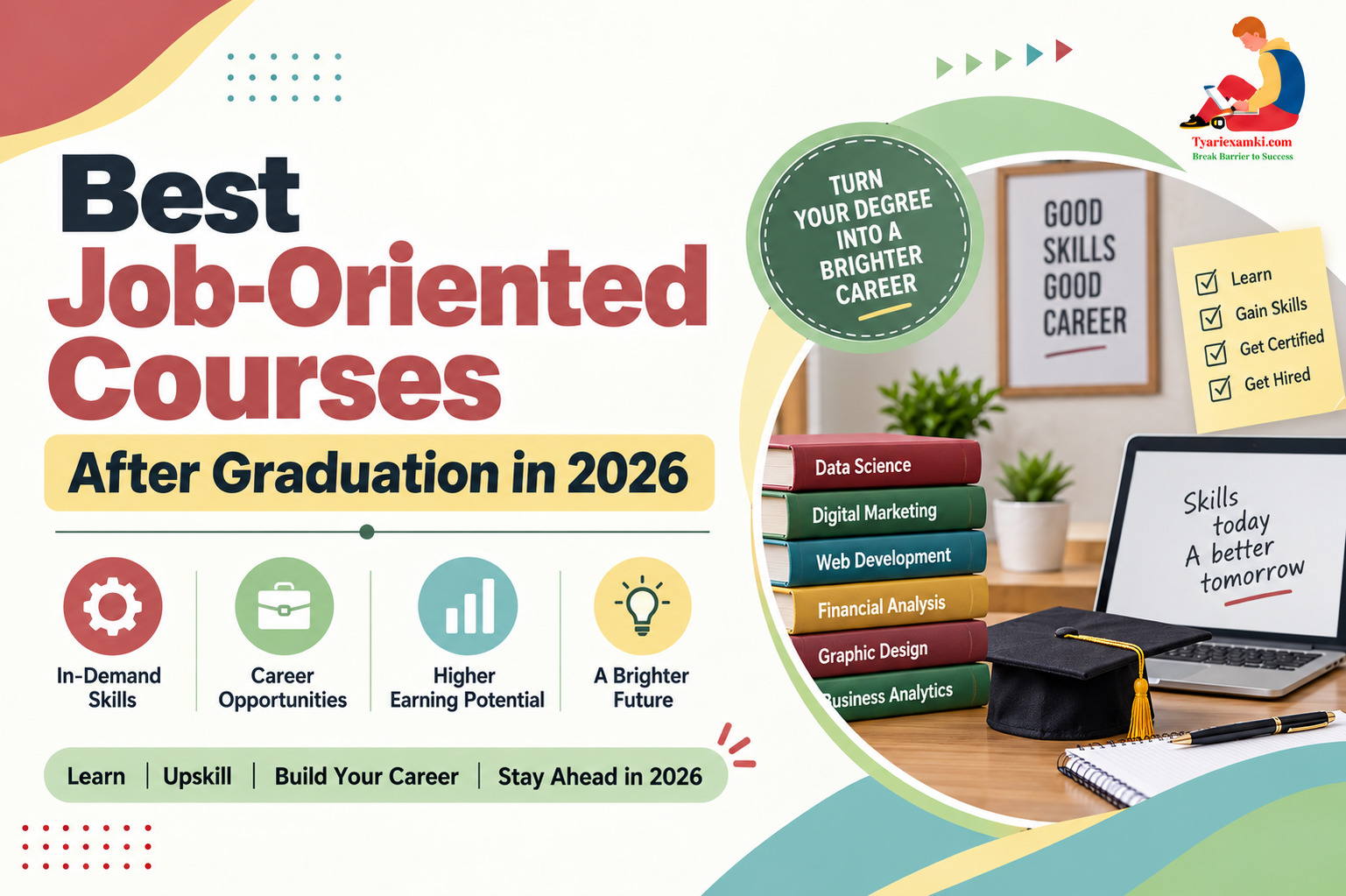
Completing graduation is an important milestone, but for many students, the next question is, what should I do after graduation to get a good job?
In 2026, having a degree is often only the beginning. Employers increasingly look for practical skills, industry knowledge, certifications, and the ability to work with modern tools. India’s current skills landscape is placing strong importance on areas such as Artificial Intelligence, data, cybersecurity, digital skills, and industry-recognized certifications.
This is precisely why job-oriented courses after graduating have become increasingly popular among students and professionals. With a decent professional course, you acquire the required skills and knowledge to enter into particular career professions without having to study for several more years for a different degree.
This guide will help you to understand the best job-oriented courses after graduation and which course is suitable for students according to their skills, interests, and what opportunities they can get.
What are the best job-oriented courses after graduation?
The best courses after graduation in 2026:
Data Analytics
Artificial Intelligence and Machine Learning
Digital Marketing
Full-Stack Web Development
Cybersecurity
Cloud Computing
Business Analytics
Tally Prime and Accounting
Human Resource Management
UI/UX Design
Content Writing and SEO
Project Management
The right course depends on your graduation stream, interests, existing skills, budget, and career goals.
Why Choose Job-Oriented Courses After Graduation?
While the graduation degree gives you academic knowledge, professional courses allow you to gain skill sets that are directly linked to your jobs.
Digital skills, data skills, AI, and cybersecurity skills continue to be in high demand in India. The 2026 NIIT India Skills Gap Report recognizes AI, cybersecurity, digital, and data skills as important skill sets.
A job-oriented course can help you:
Learn practical and industry-relevant skills
Build projects for your portfolio
Improve your resume
Prepare for job interviews
Change your career field
Develop specialized expertise
Become more confident when applying for jobs
For graduates who do not want to immediately pursue a traditional postgraduate degree, skill-based learning can be a practical alternative.
1. Data Analytics
Data Analytics is one of the most useful career options for graduates who enjoy numbers, problem-solving, and technology.
A good data analytics course generally covers tools such as Microsoft Excel, SQL, Power BI, Tableau, statistics, and basic Python.
Career options
After learning data analytics, you can explore roles such as
Data Analyst
Business Analyst
MIS Analyst
Reporting Analyst
Junior Data Analyst
Data analytics is particularly useful because companies across banking, retail, healthcare, e-commerce, finance, and other industries use data to make business decisions.
Best for: BCom, BBA, BSc, BA, and other graduates interested in numbers and business.
2. Artificial Intelligence and Machine Learning
Artificial Intelligence (AI) and Machine Learning (ML) are among the most future-focused career areas in 2026.
AI is no longer limited to traditional technology companies. Businesses are increasingly using AI for automation, customer service, analytics, content, software development, and business operations.
An AI and machine learning course may cover:
Python
Machine Learning
Generative AI
Data Processing
Deep Learning
AI Tools
Model Development
India's skills environment is also increasingly focused on AI capabilities. Current industry discussions highlight the need for graduates and professionals to develop advanced technical skills alongside domain knowledge.
Best for: Science, computer science, engineering, mathematics, and technically inclined graduates.
3. Digital Marketing
Digital Marketing is one of the most accessible job-oriented courses after graduation because graduates from different academic backgrounds can enter this field.
A comprehensive digital marketing course can include:
Search Engine Optimization (SEO)
Social Media Marketing
Google Ads
Meta Ads
Content Marketing
Email Marketing
Google Analytics
Online Branding
Career opportunities
You can work as a:
Digital Marketing Executive
SEO Executive
Social Media Executive
Performance Marketing Executive
Content Marketing Executive
Digital Marketing Specialist
Digital marketing can also be useful for freelancers, entrepreneurs, and students who want to start an online business.
Best for: BA, BCom, BBA, BCA, and graduates interested in marketing, communication, and online business.
4. Full-Stack Web Development
If you enjoy coding and technology, full-stack web development can be a strong career option.
Full-stack developers work on both the front and back end of the website and applications.
A typical course may teach:
HTML
CSS
JavaScript
React
Node.js
Databases
APIs
Git and GitHub
Practical experience is one of the most important parts of the development course. Try to choose a program that includes real projects rather than only theoretical lessons.
Career options: Front-End Developer, Back-End Developer, Full Stack Developer, and Web Developer.
5. Cybersecurity
As organizations become more dependent on digital systems, protecting data and networks has become increasingly important.
A Cybersecurity course can introduce students to:
Network Security
Ethical Hacking
Cyber Threats
Security Testing
Risk Management
Data Protection
Security Tools
Cybersecurity is particularly suitable for graduates who enjoy technology, problem-solving, and security-related work.
Career options: Cybersecurity Analyst, Security Analyst, SOC Analyst, and Information Security Associate.
6. Cloud Computing
Cloud technology is another valuable skill for graduates interested in IT.
Cloud computing courses may introduce platforms and concepts related to AWS, Microsoft Azure, Google Cloud, cloud infrastructure, networking, and DevOps.
Cloud skills can be useful for IT support, infrastructure, development, and operations roles.
Best for: BCA, BSc, engineering, and other graduates with an interest in technology.
7. Tally Prime and Accounting
For commerce graduates, Tally Prime and accounting courses can provide a practical route toward finance and accounting jobs.
Students can learn:
Tally Prime
GST
Bookkeeping
Financial Accounting
Payroll
Inventory Management
Basic taxation
Business reporting
These skills can be useful for roles in accounting firms, companies, small businesses, and finance departments.
Career options: Accountant, Accounts Executive, GST Executive, and Finance Assistant.
8. Human Resource Management
If you enjoy communication, organization, and working with people, Human Resource Management can be a suitable professional career path.
A practical HR course can cover:
Recruitment
Employee Management
Payroll
Performance Management
HR Operations
Employee Relations
HR Analytics
HR professionals are needed across almost every industry.
Career options: HR Executive, Recruitment Executive, HR Coordinator, and HR Operations Executive.
9. UI/UX Design
For creative graduates interested in technology and design, UI/UX Design is another career-oriented option.
Students can learn:
User Research
Wireframing
Prototyping
Figma
User Interface Design
User Experience Principles
A strong portfolio is particularly important in this field. Your projects can demonstrate your design thinking to potential employers.
Career options: UI Designer, UX Designer, Product Designer, and Junior UX Researcher.
10. Content Writing and SEO
If you have strong writing and communication skills, Content Writing and SEO can be a relatively accessible career option.
A professional course can teach:
SEO writing
Keyword research
Blog writing
Website content
Copywriting
On-page SEO
Content strategy
Basic analytics
You can work with digital agencies, websites, startups, media companies, or as a freelancer.
Career options: Content Writer, SEO Executive, Copywriter, and Content Strategist.
How to Choose the Right Job-Oriented Course After Graduation?
Before enrolling in any course, ask yourself five simple questions:
1. What is my career goal?
Do you want a job in IT, finance, marketing, design, HR, or another field?
2. What skills do I already have?
Your existing knowledge can help you choose a course that is easier to understand and more useful for your career.
3. Does the course include practical projects?
Projects, assignments, and portfolio work are important because they allow you to demonstrate what you can actually do.
4. Does the course teach current tools?
Technology changes quickly. Make sure the curriculum includes relevant and updated tools.
5. Does the course provide career support?
Resume building, interview preparation, mock interviews, and career guidance can be useful for fresh graduates.
Best Job-Oriented Courses After Graduation Based on Your Degree
Short-Term Courses vs. Long-Term Courses
If your primary aim is to get employed as soon as possible, then you might consider short-term professional courses. Courses in topics like digital marketing, SEO, Tally Prime, content writing, and basic data analytics would likely be shorter courses.
On the other hand, advanced fields such as AI, machine learning, full stack development, and cybersecurity generally require more time and continuous practice.
The important thing is not simply completing a course. The goal should be developing a skill that you can demonstrate to an employer.
How Tyariexamki Can Help
Making the correct decision about your future career path can be difficult because there are so many courses are available. Tyariexamki helps students who wish to make a successful career in their selected courses by giving proper guidance and learning.
Students should not join a particular course just because it is currently trending.
Final Thoughts
The best career-oriented courses for after graduating in 2026 should include elements of education that can be practically used in the future career. Rather than choosing a course on the basis of high salary, it is recommended to choose one that is suitable for your interests and education.
For technology-oriented careers, one may choose AI, Data Analytics, Full Stack Development, Cloud Computing and Cyber Security as useful career-oriented courses. In the case of creative and business careers, Digital Marketing, SEO, UI/UX Design and Content Writing are useful. Commerce students can also go for Tally Prime, Accounting and finance courses.
Above all, one must continue learning even after taking up the course. Current research in the industry indicates that digital, data, AI, and cybersecurity skills have become increasingly important for employability.
Choose a skill, practice it, build real projects, and then use that skill to build your career.
FAQs
1. What are the best job-oriented courses after graduation in 2026?
Some of the key job-oriented courses after graduation in 2026 include Data Analytics, AI and Machine Learning, Digital Marketing, Full Stack Web Development, Cybersecurity, Cloud Computing, Tally Prime, HR Management, UI/UX Design, Content Writing, and SEO.
2. Which course is best after graduation for getting a job quickly?
Short-term courses such as Digital Marketing, SEO, Tally Prime, Content Writing, and basic Data Analytics can be considered by graduates looking for skill-based career options.
3. Which job-oriented course is best for BA graduates?
BA graduates can consider Digital Marketing, Content Writing, HR Management and UI/UX Design based on their interests and existing skills.
4. Which courses are suitable for BCom graduates?
BCom graduates can consider Tally Prime, Accounting, Data Analytics and Digital Marketing as practical career-oriented options.
5. Which courses are best for BCA graduates?
BCA graduates can consider Full Stack Development, Data Analytics, Cloud Computing and Cybersecurity.
6. Is Digital Marketing a good course after graduation?
Digital Marketing is an accessible option for graduates from different academic backgrounds. It can cover SEO, social media marketing, Google Ads, Meta Ads, content marketing, and analytics.
7. Is Data Analytics a good career option after graduation?
Data Analytics can be useful for graduates interested in numbers, problem-solving, and technology. Courses commonly cover Excel, SQL, Power BI, Tableau, statistics, and basic Python.
8. Which short-term courses can I take after graduation?
Digital Marketing, SEO, Tally Prime, Content Writing and basic Data Analytics are examples of shorter professional courses mentioned in the article.
9. How do I choose the right job-oriented course after graduation?
Consider your career goal, existing skills, practical project opportunities, the tools taught in the course, and available career support before enrolling.
10. What skills should graduates develop for better career opportunities in 2026?
The article highlights practical skills in areas such as AI, data, cybersecurity, digital skills, and industry-recognized certifications, along with hands-on projects and current tools.