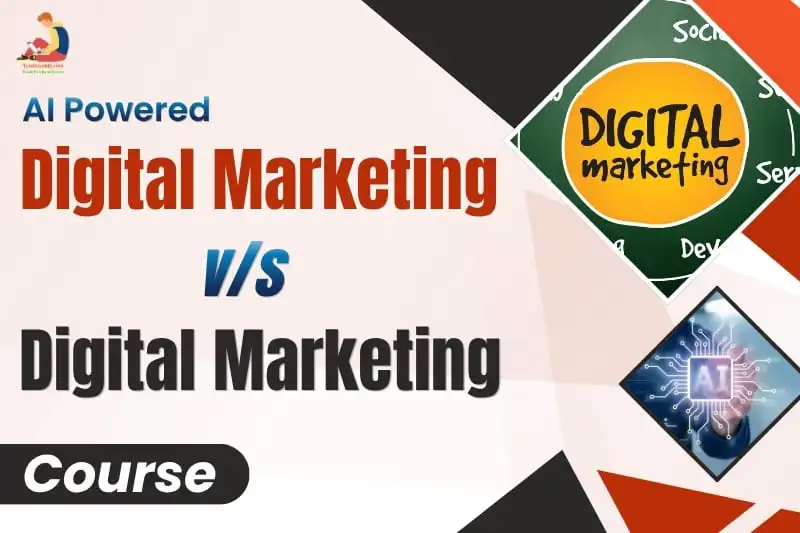
If you are a student in Delhi comparing digital marketing courses in 2026, you have probably come across one question more than any other: should I learn traditional digital marketing, or should I go straight for an AI-powered digital marketing course? The answer affects your starting salary, your job options, and how quickly you become employable — so it deserves a clear, honest answer.
The short version is this: traditional digital marketing built the industry. The skills it established — SEO, Google Ads, social media management, email marketing, and content creation — remain the foundation of every digital marketing job in the market today. They are not going away. What has changed is the speed and scale at which companies expect those skills to be applied — and that is exactly where AI tools make the difference.
An AI-powered digital marketing course does not replace traditional skills. It adds a second layer on top of them — teaching you how to use tools like ChatGPT, Canva AI, Jasper, and Midjourney to produce better work faster, automate repetitive tasks, and deliver results that a manually trained marketer simply cannot match at the same speed. The result is a candidate who earns 30 to 40% more at the entry level, gets hired faster, and can offer significantly higher-value freelance services from Day 1.
What Is Digital Marketing?
Promoting goods, services, and brands online with manual tools and platform capabilities is known as digital marketing. Businesses changed their traditional marketing strategies in the 2010s from using print, radio, television, fliers, and cardboard to using digital channels and advertisers— and it produced an entire generation of skilled digital marketers who built careers on these foundations. At its core, traditional digital marketing is built around six disciplines that remain relevant today.
Search Engine Optimisation (SEO) involves improving a website's visibility on Google through keyword research, on-page content optimisation, technical site improvements, and link-building. A traditional SEO practitioner researches keywords manually, writes optimised content by hand, and monitors rankings through tools like Google Search Console and Screaming Frog.
Google Ads and PPC involves creating paid search campaigns where advertisers bid on keywords and pay for each click their ad receives. A traditionally trained PPC executive sets up campaigns manually, writes ad copy from scratch, adjusts bids based on performance data, and interprets reports through Google Ads and Google Analytics.
Social Media Marketing covers content planning, community management, and paid advertising across platforms like Instagram, Facebook, and LinkedIn. Traditional social media marketers create content manually, post on fixed schedules, and run ad campaigns through Meta Ads Manager.
Email Marketing involves building subscriber lists, designing campaign templates, writing copy, and sending emails through tools like Mailchimp or HubSpot. Traditional email marketers segment their audiences manually and monitor open rates, click rates, and conversions through platform dashboards.
Content Marketing and Blogging focuses on creating written, visual, and video content that attracts organic traffic and builds brand authority. In a traditional setup, content is researched, written, edited, and published entirely by human effort.
Analytics and Reporting involves tracking campaign performance through Google Analytics 4, Looker Studio, and platform-native dashboards. Traditional marketers pull data manually, build reports in spreadsheets, and draw conclusions from the numbers themselves.
What traditional digital marketing teaches students:
How search engines rank content and how to influence those rankings
How to structure and manage Google Ads campaigns from account setup to optimisation
How to plan and execute social media content and paid campaigns
How to design and send email marketing campaigns with proper segmentation
How to read performance data and make decisions based on what the numbers show
How to write content that serves both search engines and human readers
How to manage advertising budgets across multiple platforms simultaneously
Traditional digital marketing education has proven its value over more than a decade. The skills are real, the career outcomes are documented, and the foundational knowledge it provides does not become irrelevant simply because new tools exist. Where it begins to show its limitations is in speed, scale, and the growing gap between what manually trained marketers can produce and what the job market now expects.
What Is AI-Powered Digital Marketing?
AI Powered Digital Marketing also covers the top six core modules SEO, paid advertising, social media, email, content and analytics but along with this modules also integrates artificial intelligence tools at every workflow. This AI in digital marketing, is not about replacing marketing knowledge its also about how to use AI tools in marketing, to get better result
In practical terms, this means a student learning AI-powered digital marketing at Tyariexamki is not just learning how to run a Google Ads campaign — they are learning how to use AI tools to generate multiple ad copy variations, analyse performance data automatically, identify optimisation opportunities in real time, and build automated workflows that reduce the manual effort required to maintain a campaign.
Upgrade Your Skills with AI – Enroll Today & Boost Your Career Earnings
AI tools integrated into every module:
ChatGPT and Gemini — for content drafting, keyword clustering, campaign ideation, and research summarisation
Claude — for long-form content, strategy documents, email sequences, and data interpretation
Jasper — for high-volume marketing copy including ad headlines, product descriptions, and landing page content
Canva AI — for AI-assisted graphic design, social media creatives, and brand visual content
Midjourney — for generating original image assets for campaigns without requiring a design team
Synthesia — for producing AI-powered video content and explainer videos without a studio setup
Prompt Engineering — the standalone skill of writing precise, structured instructions that produce consistently high-quality AI output across all tools
Automation skills added in AI-powered programmes:
WhatsApp automation for lead generation, customer queries, and follow-up sequences
CRM integration to connect marketing channels and automate client communication
Sales funnel architecture to move prospects from awareness to conversion automatically
Email drip campaigns that run without manual intervention once configured
Multi-channel marketing automation workflows that operate across platforms simultaneously
In this AI for Digital Marketing course is not about knowing various tools—it is about how to produce significantly more output at higher quality.
Digital Marketing v/s AI-Powered Digital Marketing — Key Differences
Skills and Tools Comparison
Why Students Should Learn AI-Based Digital Marketing?
Employers now prefer candidates who are skilled in tools like ChatGPT, automation platforms, and content generation systems. Compared to traditional digital marketers, AI-trained candidates often earn significantly higher salaries even at the beginner level. Similarly, freelancers with AI skills can offer advanced services like automated lead generation systems and content creation, which helps them earn multiple times more than basic service providers. For upgrade their knowledge students should learn digital marketing with AI.
Key Benefits of Learning AI-Based Digital Marketing
Higher salary opportunities (30–40% more than traditional roles)
Increased freelance income (2–4X higher earning potential)
Ability to automate marketing tasks and save time
Better adaptability to industry changes
Strong competitive advantage in job market
Early mover advantage due to low competition
👉 Start learning AI-powered digital marketing Course in Rajouri Garden
What is The Job Criteria & Salary Range?
This comparison is based on current Delhi NCR hiring data and placement records at Tyariexamki — updated May 2026.
What Is New in Digital Marketing with AI?
With an AI tools digital marketing is not changed completely. In fact, the basics of marketing are the same" only added Artificial Tools which make work more easy and automatics. Understanding the AI tools has become important for everyone who are involved in this field
Generative content at scale means a marketer can produce hundreds of ad copy variations, dozens of blog outlines, and weeks of social media content within hours rather than days, using tools like ChatGPT, Claude, and Jasper with well-structured prompts.
Predictive audience targeting allows AI-powered ad platforms to identify and reach users who are most likely to convert — based on behaviour patterns, purchase history, and real-time signals — far beyond what manual audience segmentation could achieve.
AI-generated video and creative content through tools like Synthesia and Midjourney allows marketers to produce professional-quality videos and images without hiring a production team, reducing content costs dramatically for small businesses and agencies.
Automated lead nurturing through WhatsApp bots, CRM workflows, and email automation means that a prospect who fills a form at midnight receives a personalised follow-up immediately, without any human involvement, increasing conversion rates significantly.
Real-time campaign optimisation using AI tools means that instead of reviewing a campaign's performance weekly and making manual adjustments, marketers can receive AI-generated recommendations daily — or even hourly — based on live data.
Prompt engineering as a core marketing skill is entirely new to the field. The ability to write clear, structured instructions that produce high-quality, specific AI output is now a standalone competency that employers list in job descriptions and clients pay freelancers to apply.
"Final Verdict: Which Should You Choose?
Traditional digital marketing built an industry. The skills it established — keyword research, campaign management, content creation, and analytics — remain the foundation of everything that happens in online marketing. That foundation is not going away.
Tyariexamki's AI-Powered Digital Marketing Mastery Program is built to produce exactly that kind of marketer — one who carries the foundational knowledge of traditional digital marketing and the practical, job-ready AI skills that the 2026 hiring market is actively seeking.
📞 Call / WhatsApp: +91-9953092072 📍 A-16, First Floor, Rajouri Garden, New Delhi — 110027 ⏰ Open Monday to Saturday, 9:00 AM to 7:00 PM.
✍️ By Tyariexamki Editorial Team | 📅 Published: April 24, 2026 | 🕒 Last Updated: April 25, 2026 | ⏱️ 9 min read
Frequently Asked Questions
1. What is the difference between AI Powered Digital Marketing and a traditional Digital Marketing Course?
A traditional digital marketing course focuses on SEO, Google Ads, social media marketing, and content creation. An AI Powered Digital Marketing course includes these modules plus AI tools for automation, analytics, campaign optimization, and faster content generation.
2. Which course is better in 2026: AI Powered Digital Marketing or Digital Marketing Course?
In 2026, AI Powered Digital Marketing is considered better because businesses now prefer marketers who know both traditional marketing skills and AI tools. It offers better career growth and updated industry knowledge.
3. Can beginners join an AI Powered Digital Marketing course?
Yes, beginners can join easily. Most AI digital marketing courses start with basics like SEO, social media, and Google Ads, then gradually introduce AI tools for better learning.
4. Does an AI Powered Digital Marketing course include SEO training?
Yes, a quality AI Powered Digital Marketing course includes SEO modules such as keyword research, on-page SEO, technical SEO, link building, and Google Search Console training.
5. What job opportunities are available after completing an AI Digital Marketing course?
After completing the course, students can apply for roles such as Digital Marketing Executive, SEO Specialist, PPC Analyst, Social Media Manager, Content Strategist, and AI Marketing Specialist.
6. Is AI replacing digital marketers?
No, AI is not replacing digital marketers. AI helps automate tasks and improve productivity, but human creativity, strategy, and decision-making are still essential. Marketers who use AI have better opportunities.
7. What tools are taught in an AI Powered Digital Marketing course?
Students usually learn tools like Google Analytics, Google Ads, Search Console, ChatGPT, Canva, keyword research tools, and marketing automation software.
8. How long does it take to complete an AI Digital Marketing course?
Most AI Powered Digital Marketing courses take around 3 to 6 months depending on course level, modules, and whether practical training or internship is included.
9. Is certification provided after completing the course?
Yes, most professional institutes provide certification after successful completion. Certifications help improve resumes, job applications, and professional credibility.
10. Who should choose AI Powered Digital Marketing over a regular course?
Students, job seekers, freelancers, business owners, and working professionals who want future-ready skills should choose AI Powered Digital Marketing because it combines marketing knowledge with advanced AI tools.