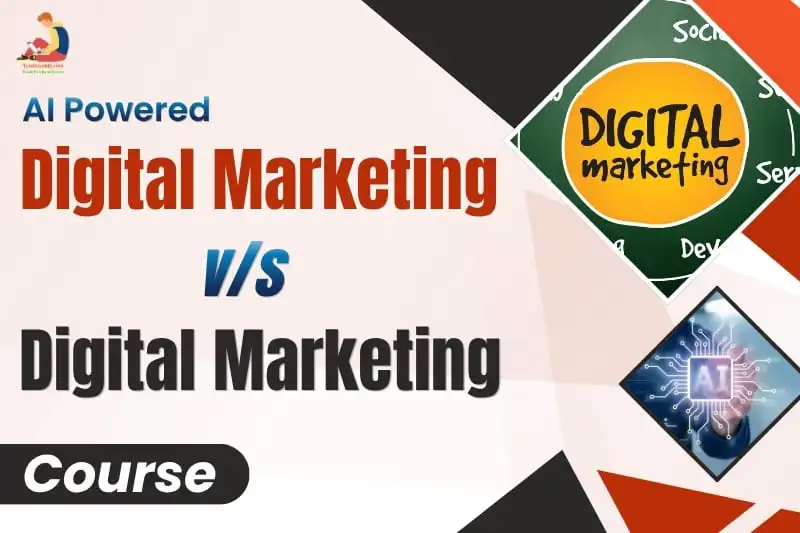
If you are sitting on this decision right now, honestly, you picked the right moment to think about it.
Because what you choose to learn in the next 4–6 months is not just about a certificate. It decides the salary range you enter at, the job titles you can apply for, and whether your skills stay relevant three years from now or quietly become outdated.
I want to give you a real picture—not a sales pitch. So this comparison draws from what employers in Delhi NCR are actually posting jobs for, what students from Tyariexamki have shared after completing both types of training, and what the numbers on salaries and hiring look like today.
What AI-Powered Digital Marketing Really Means?
There is a lot of confusion around this term, so let me clear it up first.
AI-powered digital marketing is not a completely different subject. It is the same digital marketing you already know — SEO, ads, content, social media — but done using AI tools that make the work faster, smarter, and far less dependent on guesswork.
In practical terms, a student in an AI-integrated course learns how to write and optimize content using tools like ChatGPT, Claude, and Gemini. They learn keyword research through platforms like Semrush AI and Surfer SEO, which tell you exactly what to write and how to structure it. They learn how ad campaigns can be automated and how budget decisions can be driven by machine learning rather than gut feel. They also learn something that most traditional courses have not caught up with yet—AEO, or Answer Engine Optimization, which I will explain properly in a bit.
The practical difference between traditional and AI-trained marketers is mostly about time. A blog post that takes a traditional marketer five or six hours—research, outline, draft, and revisions—can be completed in under two hours by someone using AI tools properly. And the quality is often better because the decisions are backed by data, not instinct.
What is a digital marketing course?
Digital marketing covers the skills that have built the internet marketing industry over the past fifteen years — and they are genuinely not obsolete.
SEO, Google Ads, social media management across Facebook, Instagram, and LinkedIn, email marketing, content writing, Google Analytics, and basic website handling through WordPress. These are the foundations.
Every business, whether it is a small startup in Noida or an established brand in Gurugram, still needs someone who understands these channels. The shift happening in 2026 is not that these skills have stopped mattering — it is that companies now expect them to be executed with AI tools layered on top, rather than purely by hand.
A Straight Comparison
The Salary Gap—Why AI-Trained Marketers Earn 30–40% More?
The difference is not a small gap you can ignore. At the entry level, AI-trained digital marketers in India are earning 30 to 40 percent more than their traditionally trained peers. That disparity widens much more at the mid-career stage. If we talked about the salary range, of course an AI-based digital marketer would earn more.
The reason is not complicated. Most digital marketing professionals working today built their skills before AI tools became mainstream. They can run a Google Ads campaign and write decent content—but they cannot automate workflows, produce data-driven content at scale, or optimize their output for AI-powered search results. Businesses desperately need people who can do all of this, and the supply is thin.
In Delhi NCR specifically, job listings that mention AI marketing skills, prompt engineering, or AI content strategy almost always carry a salary premium over standard roles. At Tyariexamki, we have seen this play out in our own placement data — students from AI-integrated batches consistently receive higher opening offers compared to those from our traditional batches.
Which Course Should You Choose?
There is no single answer that works for everyone, so here is a framework.
Go with a traditional course if you have zero marketing background and want to build proper fundamentals before adding AI skills. There is nothing wrong with this path — mastering the basics first and adding AI tools in three to six months is a valid route. It also makes sense if you are targeting entry-level roles managing basic social media or email marketing for a small business—those jobs exist, they hire regularly, and they are a reasonable starting point.
Choose an AI-powered course if you already have some marketing exposure and want to level up; if you are a fresher who wants a genuine edge in a crowded job market; if the salary difference matters to you from the start; or if you want your skills to stay relevant through the end of the decade.
Honestly? For most people reading this in 2026, the AI course is the better bet. The extra four to eight weeks of learning is a very small trade-off when you compare it against a 30 to 40 percent salary advantage and a much wider range of job titles you become eligible for.
The Specific AI Tools a Good Course Should Teach
A course that just talks about AI without teaching you real tools is not worth your time. Here is what hands-on training should actually cover:
ChatGPT and Claude are not for generating random content, but for structured content production: blog drafts, ad copy variations, email subject line testing, and social media captions. The skill here is learning to write prompts that produce genuinely usable output.
Google Gemini — embedded directly into Google Workspace and Google Ads. Useful for reading campaign performance, getting audience insights, and pulling content suggestions without leaving the Google ecosystem.
Semrush AI and Surfer SEO are both used for keyword research and content planning. These tools go beyond just showing search volumes — they tell you specifically how to structure an article to rank above existing results.
Make and Zapier are workflow automation tools. Think of these as the connectors between your different marketing tools. Approved content automatically posts to multiple platforms. Email sequences trigger based on user actions. Weekly performance reports are generated without anyone manually pulling data.
Meta AI features—within Meta Ads Manager, AI now handles a significant portion of audience targeting, creative variation testing, and budget allocation across Facebook and Instagram.
Google Analytics 4 with AI Insights—GA4 now flags traffic anomalies, explains user behavior patterns, and offers forward-looking performance predictions. Knowing how to use these features properly separates a skilled analyst from someone just reading dashboards.
AEO — The Skill Most Courses Have Not Caught Up With Yet
Search behavior is changing. A growing number of people never click a search result anymore — they get their answer directly from Google's AI Overview, or they ask ChatGPT or Perplexity and take that response at face value.
SEO, as traditionally understood, optimizes your content to appear in Google's blue link results. AEO—Answer Engine Optimization—takes this further. It is about structuring your content so that AI systems select it as the answer when someone asks a question.
This is not just a technical exercise. Generic, AI-stuffed content is actually performing worse in AI responses. What gets selected is well-structured, genuinely informative content with clear authority signals. So AEO is as much about writing quality as it is about technical formatting.
At Tyariexamki, AEO is part of the AI digital marketing curriculum. It covers how to structure content for featured snippets and AI overviews, how to write FAQ sections that AI systems extract as direct answers, how to use schema markup so AI can read your content more accurately, and how to build the kind of topical depth that makes AI systems treat your site as a reliable source.
What Jobs Look Like After Each Path?
After a traditional digital marketing course, the common entry roles are SEO Executive (₹18,000–₹22,000), Social Media Executive (₹18,000–₹25,000), Content Writer with SEO skills (₹20,000–₹28,000), and Email Marketing Coordinator (₹20,000–₹25,000). These positions are hiring, but competition is fierce. The supply of traditional digital marketers has grown enormously over the past five years, and employers have become selective.
After an AI-powered digital marketing course, the entry roles shift noticeably: AI Marketing Specialist (₹28,000–₹38,000), Performance Marketing Executive with AI tools (₹25,000–₹35,000), Growth Marketing Analyst (₹30,000–₹42,000), and Content Strategist with AI production experience (₹28,000–₹36,000). You are competing in a smaller pool for higher-paying positions since fewer individuals possess these abilities.
A Final Honest Take
If you are choosing a course in 2026, choose the one that teaches you both the foundation and the AI layer simultaneously. Learning traditional digital marketing first and AI later costs you time, opportunity, and approximately 30-40 percent of your potential starting salary.
At Tyariexamki, Rajouri Garden, our AI-powered digital marketing course runs 4-6 months with live sessions, real project work, AI tool access, and a paid internship. Book your free demo class and decide after you have experienced the training firsthand.
📍 A-16, First Floor, Rajouri Garden, New Delhi — 110027 📞 +91 9953092072 | WhatsApp: +91 9953092072 2 minutes' walk from Rajouri Garden Metro Station, Blue Line
Frequently Asked Questions
Is AI digital marketing harder to learn than traditional digital marketing?
Not significantly harder —itis more layered. You learn the same foundational skills (SEO, ads, content, analytics) plus how to use AI tools to execute them faster. The additional complexity comes from the tools themselves, which are designed to be user-friendly. Most students at Tyariexamki, who had no prior marketing experience, completed the AI-integrated course without major difficulty.
Do I need technical or coding skills to learn AI digital marketing?
No. None of the AI marketing tools taught in a practical course require coding. ChatGPT, Claude, Semrush AI, and Surfer SEO are all designed for marketers — not engineers. The skill you need is the ability to think analytically and write effective prompts, which is taught in the course.
Which is better for freshers—an AI or a traditional digital marketing course?
For a fresher in 2026, the AI-integrated course is the better investment. The salary gap at the entry level is 30-40 percent, the job roles are more varied and in higher demand, and the skills are more future-proof. The only reason to choose a traditional course first is if the AI course timeline does not fit your schedule—in which case, learn the basics and add AI skills as soon as possible.
How long does it take to complete an AI digital marketing course?
At Tyariexamki, our AI-powered digital marketing course runs for 4-6 months with 3 live sessions per week. All sessions are recorded for students who miss a class. The curriculum includes a 2-month paid internship where you apply AI tools on real client campaigns.
Can traditional digital marketers switch to AI digital marketing?
Yes — and this is one of the most common transitions we see. Existing digital marketers typically need 6-12 weeks to add AI tool proficiency to their existing skills. The foundational knowledge of SEO, ads, and analytics they already have makes the AI layer easier to learn, not harder.
What is the fee for Tyariexamki's AI digital marketing course in Rajouri Garden?
The AI-powered digital marketing course is available at ₹18,000 + GST, including access to all AI tools during training, a 2-month paid internship, a course completion certificate, and placement support for 6 months. A free demo class is available before enrollment—contact us at +91 9311565520 or visit our Rajouri Garden center.
Is AEO (Answer Engine Optimization) taught in Tyariexamki's course?
Yes. AEO is a dedicated module in our AI digital marketing curriculum. It covers how to structure content for Google AI Overviews, ChatGPT citations, and Perplexity answers—a skill most institutes have not yet added to their course